
We all know taxis, but how many know where the word “taxi” comes from?
In fact, questions such as: where does the word “taxi” come from? What is its exact meaning? And what does “taxi” mean in German? In this article, we will answer these questions and discover the fascinating origins of this widespread word.
The term “taxi” is now part of our everyday language, but few know its origins and the meaning it carries with it. From its birth linked to the taximeter, a revolutionary invention in 1891, to its global diffusion, this word tells a story of innovation and change.
The taxi has become a symbol of urban mobility, with a history that intertwines culture, technology and tradition.
So let’s find out together why the taxi is called that and what curiosities are hidden behind this word.

The origins of the word “Taxi”
The most documented and recognized origin of the word “taxi” is closely linked to the English term “taximeter cab”.
The taximeter was the real revolution that offered a concrete answer to the problem of fair, transparent and objective pricing in public transport services.
Before the taximeter, those traveling in public carriages often had to negotiate the price with the driver, inevitably giving rise to quarrels and misunderstandings. The new tool, on the other hand, guaranteed a standardized system that could also be verified by the authorities.
The etymology of the taximeter
The term “taximeter” is a fusion that derives from the French “taximètre”, attested as early as the second half of the nineteenth century.
This word is composed of two roots of great importance:
- “Taxe”: derives from French, and stands for tax or tariff. In this context, it indicates the cost of the transport service offered.
- “Mètre”: is the French word for “measure”, in turn coming from the ancient Greek “metron”.
The combination of these two terms is particularly fitting: the device was used, in fact, to measure distance or time and to determine the tariff to be applied on this basis. In short, the taximeter made spending objective and reduced the possibility of fraud or disputes.
The taximeter: the invention of Friedrich Wilhelm Gustav Bruhn
The great technological leap came in 1891, when the German engineer Friedrich Wilhelm Gustav Bruhn patented the first modern taximeter. This ingenious tool was able to record the distance traveled by the vehicle thanks to a series of gears connected to the wheels, and to calculate the driver’s fare in real time through a dial that was clearly visible even to the passenger.
The introduction of the taximeter radically changed urban public transport: the price of the ride became transparent, regulated by objective criteria and constantly verifiable. Municipal administrations and private companies quickly began to equip their cars with this tool, favoring the birth of a new professional category: that of taxi drivers, recognized and regulated in many countries.
Before the advent of the taximeter, the lack of precise rules meant that fares could vary considerably, even for similar journeys, fueling mistrust and disputes between passengers and drivers. The taximeter thus marked the end of arbitrary fare negotiation and the beginning of the modern era of urban transport for a fee.
The success of the invention was resounding. Within a few years, the so-called “taximeter cabs” began to circulate not only in large European cities such as London, Berlin and Paris, but also arrived overseas, landing in cities such as New York and Chicago. Over time, the abbreviated acronym “taxi” established the common name with which we still call this service.
🟡 🟠 ⚫️ What color are taxis in the world? Click and find out!
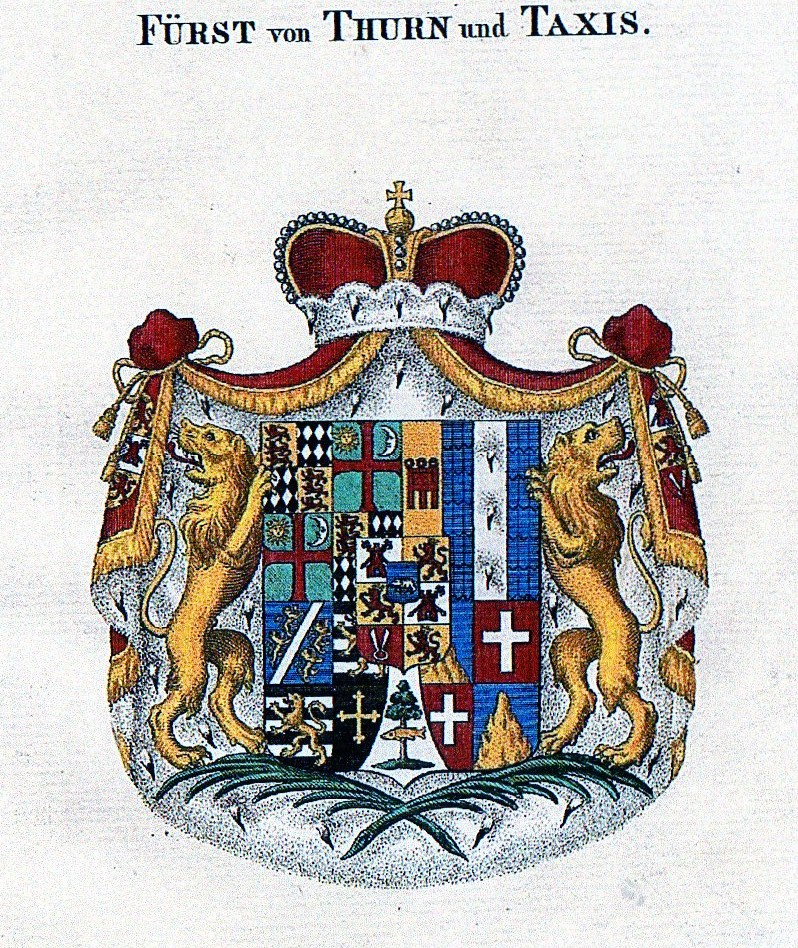
The Thurn und Taxis family
In addition to the more well-known explanation that links the term “taxi” to the taximeter, there is also a less accredited but fascinating theory that directly involves the Thurn und Taxis family.
The origins of the Thurn und Taxis family and the connection with the name “Taxi”
The Thurn und Taxis family has Italian origins, more precisely from Cornello dei Tasso, a small mountain village located in the Brembana Valley, in the province of Bergamo. Here, in the Middle Ages, the Tasso lineage was born, excellent couriers and messenger organizers who already in the fourteenth century managed important postal services for the Italian lordships and the European courts.
Over time, the Tasso family were called upon to work beyond the Alps, especially within the Habsburg Empire. They thus had the opportunity to enormously expand their communications network, reaching as far as the Netherlands and Spain. At the beginning of the sixteenth century, under the guidance of Francesco Tasso, the family received from Emperor Maximilian I the official task of organizing the imperial postal service.
It was during their move to Germany, and by imperial concession, that they changed their surname to the German form “Thurn und Taxis”.
The German name “Thurn und Taxis” comes from a Germanization of their Italian name. “Tasso” was translated to “Taxis”, while “Thurn” (meaning “tower” in German) was added to refer to the Della Torre family, with whom the Tasso family were related. This change was made official in 1650 by Emperor Ferdinand III, who granted them the right to use the name and coat of arms.
A model for Europe: the postal system of Thurn und Taxis
Thanks to their organizational skills, the Thurn und Taxis created one of the most articulated and modern mail networks in Europe between the fifteenth and nineteenth centuries. Their “post stations” were strategic points where couriers could change horses and continue without interruption, allowing the very fast transmission of letters and messages between the most important courts in Europe. The service was so efficient that it was taken as a model and often adopted – in similar forms – by other states as well.
At the end of the eighteenth century, the Thurn und Taxis family, who managed thousands of carriages and horses with which they distributed mail, decided to diversify their business, using their network and their vehicles also for passenger transport. This was a logical step, as the infrastructure was already in place and passenger transport offered a new opportunity for growth and profit.
The legacy and connection with the term “taxi”
The theory linking the family Thurn und Taxis to the term “taxi” is based on their name “Taxis”. This family, famous for operating one of the first and most efficient postal systems in Europe, has left a significant imprint on the history of transport. Their name, “Taxis”, may have inspired the modern term “taxi”, used to indicate paid vehicles.
Although the official etymology of “taxi” derives from the French “taximètre” (the device for calculating fares), the family name Thurn und Taxis and their pioneering role in transportation have led some to speculate a historical link. This connection is more symbolic than linguistic, but it emphasizes the importance of the family in the history of mobility and communications.
Thurn und Taxis and Torquato Tasso
Torquato Tasso (1544-1595), famous poet of the Italian Renaissance and author of masterpieces such as La Gerusalemme Liberata, is genealogically linked to the Tasso family, originally from Cornello in Val Brembana. Although he lived long before this lineage took the name Thurn und Taxis, his surname symbolically links him to a family that, in the following centuries, would revolutionize the postal system in Europe. Although Torquato was entirely dedicated to literature and had no involvement in postal activities, his link with this dynasty remains significant, representing a meeting point between culture and innovation in communication systems.

The global spread of the term “taxi”
The term “taxi” has crossed geographical and cultural boundaries, adapting to local languages and traditions, but maintaining its universal essence as a symbol of public transport.
Here’s how it spread and turned to different parts of the world:
Name Taxi in Europe
- France: The term “taxi” has taken root from the beginning, accompanied by the use of “taxiimètre” to indicate the device for measuring fares. France was one of the first nations to regulate the service, contributing to the spread of the term.
- Germany: In Germany, both “Taxi” and “Taxameter” are commonly used terms. This reflects the importance placed on accuracy in pricing, which is crucial for the service.
- Spain: “Taxi” is the standard term, but “taximeter” is also used to indicate the taximeter. In some regions, language variants are found that reflect local influences.
- Russia: Here the term has been adapted as “такси” (taksi), retaining both the Western sound and graphic setting, demonstrating European cultural influence.
Name Taxi in Asia
- Japan: The word “taxi” has been transliterated into “タクシー” (takushī), adapting to the phonetic and graphic rules of the Japanese language. The taxi service is highly regulated and known for its efficiency.
- China: In China, the expression “出租车” (chūzūchē) is used, which literally means “rental car”. However, the term “taxi” is recognized in the most international and touristic areas.
- India: The term “taxi”, derived from English, is widely used, but coexists with local terms such as “cab” or “auto-rickshaw”, which indicate specific and regional means of transport.
Name Taxi in Americas
- United States: In the United States, “taxi” and “cab” are both widely spread and often used synonymously. The yellow color of New York City taxis has become a global icon.
- Mexico: “Taxi” is the most common term throughout the country, but some cities adopt regional variants or colloquial terms for vehicles.
- Brazil: In Brazil, the word “táxi” is written with an accent typical of the Portuguese language. The taxi service is especially widespread in large cities, where it is regulated to guarantee rates and quality standards.
Discover the Taxis that have made history!
The “Taxi”: a historical Italianization
What are taxis called in Italy? In Italy, the term “taxi” was officially Italianized during the fascist regime, which promoted a campaign to eliminate foreign terms from the Italian language. In 1932, the newspaper La Tribuna organized a competition to find an Italian alternative to “taxi”. Among the proposals, such as “self-public” and “taxed”, “taxi” was chosen, a term that recalled the taximeter, the tool used to calculate tariffs. Although “taxi” is the most common term today, “taxi” remains a symbol of that historical period and the language policies of the time.
A linguistic journey that continues
The history of the term “taxi” is a real journey through the evolution of society. From Bruhn’s ingenious engineering leap that enabled objective pricing, to the fascinating theories linking the word to one of the earliest continental postal systems, each stage has enriched the meaning and function of the taxi in modern life.
From its origins linked to the taximeter to its global diffusion, this word continues to represent a universal symbol of mobility and connection.
FAQ in a nutshell – Frequently asked questions about the origin of the term “taxi”
Why do we say taxi?
It is called taxi because the name derives from the taximeter, the instrument that calculates the fare based on the time and distance traveled.
Where does the word taxi come from?
The word taxi derives from the French taximètre, which in turn is based on the Greek taxis (order, fare) and the Latin metrum (measure).
What does taxi mean?
Taxi means a paid public vehicle, available on request, that transports people to a specific destination.
When were taxis born?
Taxis, as we know them today, were born at the end of the nineteenth century, with the introduction of the taximeter and the first public cars in Paris and Berlin.
What were taxis once called?
Before the invention of the modern taxi, hired carriages were used, called fiacre in France or hansom cab in England.
Difference between taxi and rental with driver (NCC)?
The taxi can circulate freely and take customers on the street, while the NCC works only by reservation and has rates agreed in advance.
Who invented the taximeter?
The taximeter was invented by Wilhelm Bruhn in 1891 in Germany, revolutionizing the payment system for paid public transport.
When was the first taxi invented?
The first taximeter taxi was used in 1897 in Stuttgart, with a specially modified Daimler car.
History of urban public transport
Urban transport began with horse-drawn trams and public carriages, then evolved with buses, taxis and subways around the world.
Origin of the word taxi driver
Taxi driver derives from tax or fare, linked to the paid taxi service. Indicates the person authorized to drive a taxi.